
VETERAN ADVOCATES THRIFT EMPORIUM
HEY FOLKS........ THIS EMPORIUM AND THRIFT STORE IS FANTASTIC AND SUCH AN ARRAY OF ITEMS AND CLOTHING!!!!!! GIVE US A SHOT AND COME ON DOWN TO CHECK US OUT YOU'LL HAVE A GOOD TIME!!!!
Veteran Advocates of Ore-Ida has a rathar very nice Thrift Emporium with an excellent selection of donated items !! The prices range from 50 cents up - depending on the kind of items you are shopping for - We have an absolutely WONDERFUL staff of Volunteers eager to help you find items... it is open from 9am to 4pm Monday thru Friday - and you can bring donations Monday thru Friday from 9:30 am to 3:30pm.
Any Questions call 541-889-1978
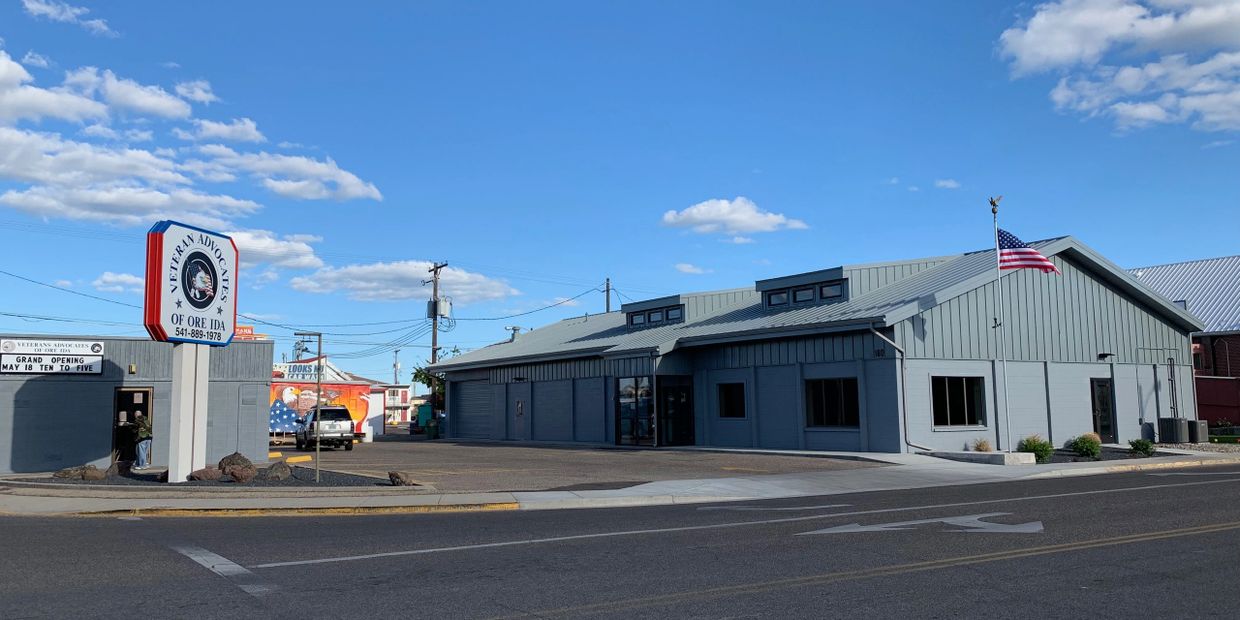
Our Campus Headquarters, Ontario, Oregon
THANK YOU FOR VISITING OUR WEBPAGE!
We thank all the Supporters, Businesses and Friends for giving their time and resources in helping and caring for our Veterans, Military and First Responders and their Families.
We really appreciate your interest too, in 'Who we are and What we do'. If you have any questions or suggestions or would like to 'volunteer' or 'donate', well please contact us with an email or a phone call. Our hours are 9am to 4pm, M/F, so come on in enjoy the conversations and coffee and browse our Museum.
We are a "No Dues' nonprofit organization with the coffee pot always on and lots of conversation always available. Bring your questions regarding any veteran services you are concerned about, and we will do our best to steer you in the right direction.
Our phone is 541-889-1978, and we are located in Ontario, Oregon at 180 W. Idaho Ave.
BI-MONTHLY ARTICLES AND A FEW STORIES OF INTEREST
Veteran Articles published Bi-monthly
THE STORY BEHIND THE DAY OF THE DEPLOYED

The Chairman of Veteran Advocates of Ore-Ida, Ronald Verini, writes two articles every month for publication in a Regional Newspaper, this article ."E.RASING BLOODSTAINS?..."
will be published OCTOBER 14, 2026 Here is a part of Mr. Verini's article, and you can read the full article by clicking the red bar below.
.
Erasing the Bloodstains?
October 14th, 2026 | Veterans Column by Ronald Verini
I write this because I am concerned of what might happen if we cleanse our past. I don’t know if this is actually happening but with the current rhetoric floating around it might be something to consider before it happens. To look at the horizon of our nation’s future, we must first be willing to stare directly into the sun of our past, even when it burns. As a veteran, I remember standing on the precipice of duty, fueled by the conviction that I was an instrument of good. Yet, coming home from Vietnam was a cold immersion into national vitriol. To some, we were "baby killers"; to others, the silent ghosts of a mistake they wanted to forget. Today, as my voice grows louder, I find myself shouting into a canyon where the echoes of "we don’t care about the past" bounce back. We are standing at a crossroads where experience is traded for expediency, and the very records of our failures, the ones that could save our children, are being threatened by the clinical click of a government delete button.
There is a specific kind of wealth that cannot be ignored: the wealth of a life lived through the consequences of national policy. Every generation seems cursed to believe they are the first to encounter fire, insisting on touching the stove themselves rather than listening to the person with the scars. We are currently watching a cycle where we repeat the same "stupid things" because we have replaced historical study with modern hubris. The wisdom gained from the Vietnam era isn't just about troop movements; it’s about the soul of a nation that learned what happens when the government loses the trust of its people. If we ignore those lessons, we aren't just being forgetful; we are being dangerous.
From a military perspective, history isn't a "feeling," it is the ultimate After Action Report (AAR). In the field, you don’t document what you wished happened; you document what did happen so the next squad doesn't get ambushed in the same clearing. There is a chilling trend of government entities looking to "curate" historical records that portray American history in a negative light. This is not just about political optics; it is a tactical error of the highest order. When you eliminate the "bad" from the record, you eliminate the map of the minefield. If we sanitize the Vietnam War or scrub the dark chapters of our treatment of Native Americans, we aren't protecting our reputation; we are lobotomizing our national intelligence. A military that guesses based on a sanitized past is a military that bleeds unnecessarily.
We live in an era where an IT staffer can wipe away decades of nuance with a few keystrokes. This is not a partisan issue; it is a human one. We should be terrified of a government that views history as a "living document" edited to fit the current mood. Restoring truth takes decades of study, but erasing it takes a microsecond. We cannot allow the "bad" to be wiped out because the "bad" is where the medicine is. History is not a trophy room; it is a laboratory. If we throw out the failed experiments, we will never find the cure for the social and political diseases that currently plague us.
THE STORY BEHIND THE DAY OF THE DEPLOYED
THE STORY BEHIND THE DAY OF THE DEPLOYED

Did you know that Day of the Deployed was founded by Soldiers’ Angels? Each year on October 26th, we honor the brave men and women who are deployed through this National holiday. Day of the Deployed was started by Soldiers’ Angel volunteer Shelle Michaels Aberle. In 2006, Shelle approached the governor in her home state of North Dakota (Governor John Hoeven) with a request for a proclamation and special day to honor Active Duty men and women serving outside the U.S. October 26 was chosen because it was the birthday of her cousin, U.S. Army Lt. Col. David Hosna, who was actively serving in Iraq. Governor Hoeven was the first to recognize the Day of the Deployed, and the first units honored by this proclamation were NDARNG 1-188th ADA SECFOR and JLENS deployed to Afghanistan.
The effort spread, and by 2010, 40 states had proclaimed a Day of the Deployed. In 2011, when Hoeven became a State Senator, he proposed a bill to make the day a National Day of Honor. It passed with 100% yes votes!
Here’s a look at the proclamation in Texas and from the Senate.

How to Participate
On the Day of the Deployed (October 26), we honor the brave men and women who have been deployed and are sacrificing or have sacrificed their lives to fight for our country. It’s also a day that acknowledges the families they are separated from. While there may be a celebration or initiative in your city or town, we invite anyone interested in honoring and supporting Deployed Service Members and their families to become an Angel volunteer.

Soldiers’ Angels Deployed Support
Our very first initiative as a Military organization was to support Deployed Service Members by sending care packages. We have since grown that effort to support Deployed Service Members in a number of ways and have also expanded our support to Active Duty Service Members, Military families, and Veterans of all eras. If you’re interested in supporting Deployed Service Members, we have a number of virtual volunteer opportunities to choose from!
Once you’ve signed up as an Angel volunteer and gone through our verification, you can support these heroes in the following ways.
Bake for the Deployed
Do you love to bake? Our Service Members love to receive baked items! Support Service Members with one-time care packages of baked goods. Our Angels love to bake and create all sorts of delicious treats for the troops. They send everything from brownies to lemon bars to specially decorated cookies for the holidays. They also love to share recipes and photos in our forum.

Send Cards
Sometimes Service Members (and also Veterans) need a little encouragement or are celebrating something special like a birthday. One way we show our support is by sending cards to them. Whether they’re homemade or store-bought, it’s really the thought that counts. Our Angel volunteers come together to flood that Service Member with cards from all over!

Chaplain Support
Our founder, Patti Patton-Bader realized that Chaplains were an excellent way to provide support to units. Our team works with Chaplains overseas to send support when needed. Chaplains who are registered through Soldiers’ Angels can request items related to their mission, like letters, gifts, recreational activities, baked goods, and supplies. These things go a long way towards boosting morale for Service Members who need extra support in war zones. Many times, Chaplains ask for supplies to throw special events for units who could use a lift in spirits. Halloween parties, ugly sweater parties, you name it!
Adopting a Service Member
If you’re interested in supporting a Service Member throughout the duration of their deployment, you can do that by adopting one! As Angels get to know the Service Members they support, they’ll send care packages of supplies unique to that Service Member. They often send themed care packages based on the season, holiday, or Service Member’s favorite sports team. It’s not all about what goes in the box either. Our Angels take great care to decorate the inside of the box so that there’s a fun surprise when they open it.

Letter Writing
Mail call is something every Service Member looks forward to. Receiving a letter – from anyone – can lift spirits. Unfortunately, many of our Service Members don’t get any mail from home. That’s where our Angels come in. Our Letter Writing opportunities support Service Members with a one-time letter to ensure that “no soldier goes unloved” (our motto here at Soldiers’ Angels). Angels can write as little as one letter per month, but some write as many as 50 per month! It’s a small and easy way to show your support.

These are just a few of the many volunteer opportunities we offer to show your support to Deployed heroes through Soldiers’ Angels! Celebrate the Day of the Deployed by getting started today.
HISTORIC EVENTS THAT HAPPENED IN OCTOBER

Major Historical October Events
October 1 This Day in History
John Philip Sousa becomes the Director of the US Marine Corps Band. (1880)
The first issue of National Geographic hits the newsstand. (1888)
Yosemite National Park is established. (1890)
The Television series “The Twilight Zone” premieres. (1959)
Walt Disney World opens in Orlando, Florida. (1971)
October 2 This Day in History
Peanuts comic strip by Charles Schultz first appears in newspapers. (1950)
October 3 Historical Events
Captain Kangaroo premieres on television. (1955)
The “Mickey Mouse Club” premieres on television. (1955)
Frank Robinson becomes major league baseball’s first black manager for the Cleveland Indians. (1974)
October 5 This Day in History
The World Series was broadcast on radio for the first time. (1921)
October 6 This Day in History
Thomas Edison shows the 1st motion picture. (1889)
The first Physician’s Assistants graduates from Duke University. (1967)
“CSI: Crime Scene Investigation” premieres on television. (2000)
October 8 This Day in History
The Great Chicago Fire levels 3 1/2 square miles of the city. According to legend, Mrs. O’Leary’s cow started the fire. (1871)
October 9 This Day in History
The general public was first admitted into the Washington Monument. (1888)
Ringling Brothers Barnum and Bailey Circus performs its last show, a victim of falling attendance, animal rights protests, and high operating cost. (2018)
September 11 This Day in History
Saturday Night Live premieres on television. (1984)
Space Shuttle Challenger astronaut Kathryn Sullivan became the first American woman to walk in space.
(1984)
October 13 This Day in History
The U.S. Continental Navy is created. See Navy Day (1775)
The cornerstone was laid for the Whitehouse. (1792)
October 14 Historical Events
Martin Luther King Jr is awarded the Nobel Peace Prize. (1971)
October 15 This Day in History
“I Love Lucy Show” premieres on television. (1951)
U.S. Department of Transportation was created. (1966)
Oscar the Grouch premieres on children’s television show Sesame Street. See More: National Grouch Day.(1969)
October 16 Historical Events
Marie Antoinette was guillotined for treason. (1793)
Cuban Missile Crisis begins. (1962)
October 17 This Day in History
Mobster Al Capone was convicted of income tax evasion. (1931)
Joe Pedott of San Fransisco, CA. applies for a U.S. patent for the Chia Pet. See Chia Pet Day. (1977)
October 18 Historical Events
The United States purchases the territory of Alaska from Russia for $7.2M. What a deal that was!! (1867)
Charles Perkins Strite receives a patent for the pop-up toaster. (1921)
October 19 Historical Events
The Revolutionary War ends. (1781)
The Senate passed a bill making Martin Luther King’s Birthday a national holiday. (1983)
October 20 This Day in History
Chinese uprising in the Philippines fails after 23,000 are killed. (1603)
US Senate ratifies the Louisiana Purchase. (1803)
The Future of Aerospace & Defense, Made Clear

WHAT WE DO
Forecasting, Data, and Expert Insight for Strategic Advantage
FI provides structured, future-focused intelligence that helps aerospace and defense professionals:
- Identify market opportunities
- Assess competitive positioning
- Understand modernization cycles
- Monitor global procurement programs
- Navigate the U.S. defense budget
- Support strategy, BD, and investment decisions
Our solutions combine long-range forecasts, detailed program profiles, independent analysis, and curated datasets to give your organization the clarity it needs to act confidently.
THE MOST RELIABLE SOURCE FOR AEROSPACE, POWER & DEFENSE MARKET FORECASTING
FI Global Intelligence
FI Global Intelligence is Forecast International’s flagship platform—your secure, all-in-one gateway to the most comprehensive aerospace, defense, and power systems intelligence available.
Built for strategic planners and decision-makers, it delivers continuously updated data, forecasts, and analysis across every major global market.
Deep Forecasting Coverage
Up to 15 years of forward-looking market forecasts and 10 years of historical data.
Advanced Search & Custom Queries
Filter by date range, platform, category, geography, company, and currency.
Continuously Updated Intelligence
Market segment analyses and system-level reports refreshed regularly, with interim updates issued for major developments.
Program, Market & Competitive Insight
Access authoritative profiles spanning systems, platforms, technologies, and modernization priorities.
Flexible Licensing
Available for individual users, teams, or enterprise-wide access.
Seamless Online Delivery
Secure, always-on platform combining Forecast International’s proprietary datasets with intuitive tools for fast, confident decision-making.
Why Choose Us
Delivering unmatched expertise in aerospace and defense for over 50 years with robust market intelligence and reliable forecasts.
Expert Analysis
Our world-class analysts provide detailed insights and long-range forecasts that drive informed decision-making across industries.
Tailored Solutions
We offer customized market analyses and consulting services to meet the specific needs of our clients and stakeholders.
NATO allies foil Russian subsea cable sabotage plot
By Sarah McFarlane and Gram Slattery, Reuters
LONDON/WASHINGTON — Deep in Arctic waters near the remote Svalbard archipelago this spring, NATO allies caught Russian subs training to unleash a secret weapon designed to disable critical undersea cables without leaving any fingerprints.
The clandestine Russian operation, described to Reuters by two Western officials, was carried out by Moscow’s GUGI undersea warfare directorate, which used deep-sea submersibles to simulate the deployment of the sophisticated and destructive technology.
A joint operation involving Britain, Norway and the United States tracked and confronted the Russian vessels at sea, said the two officials, speaking on condition of anonymity. The vessels were prevented from completing their exercise and eventually left the area.
Britain and Norway disclosed in April that they had uncovered a covert Russian operation in Arctic waters. But the discovery of the new weapon, the location of the operation and the U.S. involvement have not been reported.
The deep-sea face-off comes at a time when some Western intelligence officials fear the Kremlin is ramping up sabotage operations in Europe and preparing for a conflict with NATO.
Some U.S. intelligence analysts are increasingly concerned Russia may test NATO’s mutual defense pact, known as Article 5, three U.S. officials said. If it does, destroying subsea cables could be a critical part of that effort, the Western officials said.
Cables no thicker than a garden hose, lying on the seabed or buried just below, are critical to global internet connectivity and financial transactions. Their economic and strategic importance has made them targets in past conflicts, including in the First and Second World Wars, when they were critical to delivering orders by telegraph or telephone.
Two 1,400 km subsea fiber-optic cables linking Svalbard to mainland Norway lie as deep as 2,700 meters below the sea’s surface. They carry vast amounts of satellite data downloaded at the SvalSat satellite ground station, the world’s largest and part of NASA’s Near Space Network.
Russia’s Defense Ministry didn’t respond to a request for comment on the incident. The Kremlin consistently denies conducting sabotage operations in NATO countries or plotting any confrontation.
Shielding U.S. Forces from Spies that Use Location Tracking
Americans serving abroad often carry devices that can share precise location data across .multiple commercial apps, services and data-broker systems, frequently in ways users do not fully understand. They may not know it. Our adversaries do.
This is not hypothetical.
In 2018, Strava, a popular GPS-based fitness app, drew a map of one of America’s most sensitive military installations. Soldiers had simply gone for a run. When the app published an aggregated “heat map” of user activity, the GPS trails of service members illuminated base layouts and operational routines for anyone with an internet connection, not through espionage, but through data.
That vulnerability has multiplied since then. In March 2026, reporting indicated that a French naval officer’s public fitness-tracking activity exposed the location of the aircraft carrier Charles de Gaulle.
During recent tensions involving Iran, viral warnings circulated online claiming that location-enabled mobile applications could expose U.S. personnel movements, underscoring how credible and persistent this concern has become, even though military officials later said that specific message was false.
U.S. policymakers increasingly recognize that foreign adversaries, including China, can exploit commercially available sensitive data about Americans, including military personnel. These incidents reflect a simple but consequential truth: location data, when aggregated, leaked, or otherwise compromised, can reveal patterns of life, operational routines and sensitive infrastructure
The Global War on Terrorism Is Over......
Except for the Veterans Who Fought It.....
After Sept. 11, it felt like the whole country was wrapped up in patriotism. Then, slowly, Americans moved onBY MICHAEL PEREIRA SEPTEMBER 10, 2026
This month marks 25 years since the attack on Sept. 11, which started the Global War on Terrorism. A quarter century. I have three kids who weren’t even alive for any of it. To them, it’s just a chapter in a history book. For many, a war that shaped my life has faded into the background.
I went on three deployments to Iraq with 1st Battalion, 5th Marine Regiment. The initial invasion in 2003, the first Battle of Fallujah in 2004, and Ramadi in 2005. So when I say it’s faded from the national consciousness, I’m not talking about something I read about. I’ve lived it on both sides: the war itself and its aftermath.
On May 2, 2011, I watched news reports of crowds outside the White House chanting “USA! USA!” Osama bin Laden was dead, and for most of the country, that was it. The goal to avenge 9/11 was finally closed.
Except it wasn’t. Not really.
Combat troops didn’t leave Iraq until December of that year. And a decade would pass after the bin Laden raid before we left Afghanistan in August 2021—20 years after the twin towers fell. Even then, there was no formal end.
On Aug. 30, 2022, the secretary of defense signed a memo ending the National Defense Service Medal, an award most of us earned just by serving during this era.
That’s how it ended. There was no surrender. No treaty signed on a battleship. A pullout. A memo. The Global War on Terrorism kind of just ran out of momentum.
A Slow Fade
When I first got home, people wanted to know everything. “Tell me about Iraq,” they asked. “What was it like?” Yellow ribbons were stuck on cars and tied around trees. My mom had ribbons on her trees through all my deployments. On Veterans Day, restaurants gave us whatever we wanted on their menu—not some shortened list, the actual menu. People meant it when they said, “Thank you for your service.”
Founders, Funders, and Veterans Converge:
Inside the First NatSec + Space Innovation Summit
see why the future of Aerospace and Defense will be built by Veterans.
On October 8 and 9, during San Francisco Fleet Week, VetsinTech and the Bay Area Council will host the first-ever NatSec + Space Innovation Summit (NSSIS), a two-day convening built on a simple but overdue premise: the people who fund, build, and buy the next generation of national security technology should be in the same room as the veterans who have actually carried out the mission.
As VetsinTech CEO Katherine Webster puts it in her invitation to this year’s founding sponsors, the defense tech and space innovation ecosystem “was not born somewhere else and imported here. It was created here.” From Stanford and Berkeley labs to the workshops of the national laboratories to the garages of Silicon Valley, the Bay Area has quietly become the operating system for American defense innovation. NSSIS is designed to make that leadership visible, and to make sure veteran talent sits at the center of it, not the margins.
The timing is deliberate. The Department of War is in the middle of what Webster calls “the most significant overhaul of its innovation ecosystem in a generation,” shifting toward a commercial-first model built for speed: faster awards, dual-use products, and rapid transition from prototype to fielded capability. No region has more of what that shift requires: frontier AI companies, NASA Ames, the Defense Innovation Unit, and the deepest venture capital pool on earth, backed by institutions like UC Berkeley, Stanford, SRI International, and the Naval Postgraduate School. As the summit’s own framing puts it, the gap isn’t awareness. It’s human infrastructure, and that’s exactly what NSSIS exists to build.
Over two days at The Klamath in San Francisco, attendees will move between two distinct missions. Day One centers on careers, connecting transitioning service members and military spouses with defense tech and space employers actively hiring, closing with a VIP reception for workforce leaders, government partners, and industry hosts. Day Two is the Innovation Summit itself: senior leaders from each military branch’s innovation unit, venture investors, and early-stage defense tech founders, working through the funding pathways and partnership opportunities shaping the sector. The program will also feature the Bay Area Council’s first report on the region’s role in defense tech and space innovation, new research meant to anchor, not just accompany, the conversation.
None of this happens without the organizations stepping forward as founding sponsors. NSSIS is proud to welcome Arkenstone Defense, Blue Origin, Google, Holland & Knight, JPMorgan, Navier, Scale AI, and Shield Capital as sponsors of the inaugural summit, a roster spanning law, finance, AI, aerospace, and venture capital, all aligned around the same conviction: that veteran operational experience and Bay Area innovation capacity belong in the same room.
The summit is proud to welcome Victor Glover as keynote speaker. A retired U.S. Navy Captain and former NASA Astronaut, Glover piloted the Crew-1 Dragon spacecraft to the International Space Station and served as pilot on NASA’s Artemis II mission around the Moon, completing a nearly 10-day journey that carried the crew 252,756 miles from Earth. A former Naval Aviator and test pilot who has flown more than 45 aircraft, Glover embodies exactly the convergence NSSIS was built to spotlight: the operational discipline of military service paired with the frontier of American innovation.

Story from 'THE WAR HORSE' newsroom - photo from CBS news
They Survived an Iran War Drone Attack. Six Months Later, They’re Struggling to Get Care
By LEAH ROSENBAUM 8/27/26
Soldiers wounded in the attack say they have faced months of delayed appointments, referrals, and battles to get treatment for injuries that still affect their daily lives
The soldier wakes at 6 a.m. after getting only three or four hours of sleep.
He showers, shaves, and puts on his uniform by 7 a.m., even as his head pounds from a traumatic brain injury. Sometimes, while walking to a mandatory daily roll call, the piece of shrapnel still lodged in his back catches on his shirt.
He’s not in the barracks. He is recovering at the Soldier Recovery Unit at Walter Reed National Military Medical Center.
“It’s horrible,” he said. “I’m here to recover, not show up in uniform and play Army games.”
This soldier was critically wounded in the Iranian attack on Port Shuaiba, Kuwait, that killed six service members and injured dozens more. Four months later, he said, he was only recently able to see a neurologist for the first time.
“There were a lot of things that they missed that I should have done a long time ago,” he said.
His experience was not isolated.
The War Horse spoke with four Army Reserve soldiers from the 103rd Sustainment Command who were wounded in the attack. They described delayed testing and treatment, inconsistent care depending on which Soldier Recovery Unit received them, and restrictions from taking leave to visit family. All four spoke on condition of anonymity because they remain on active-duty orders and feared retaliation that could damage their careers.
The War Horse corroborated key details of their accounts through separate interviews and reviews of medical records, photographs, and documents from the attack and its aftermath.
Though the soldiers received Purple Hearts for being wounded in combat, they said the military medical system was failing to provide the care they needed. Two of them, interviewed separately, used nearly the same words: “The military sees us as numbers.”
Have information about the Iran War?
The War Horse is continuing to report on the war in Iran and service member casualties. If you have firsthand knowledge, documents, internal communications, or other information that could help our reporting, email us at tips@thewarhorse.org or learn how to submit a tip securely here. We take source protection seriously and will not publish your name without your permission.
The ‘Peacetime Effect’
Military medicine has long struggled with what researchers call the “peacetime effect.” Medical teams become highly proficient at treating combat casualties during war, only to see those skills deteriorate once the fighting is over.
A 2023 research paper by the Institute for Defense Analyses described the cycle bluntly. Military medical forces excel at combat care during wartime, the authors wrote, “but then see these gains erode after the wars end.”
The problem has concerned federal watchdogs for decades, said Rashmi Agarwal, director of defense capabilities and management at the U.S. Government Accountability Office. Her office has monitored whether military medical personnel receive enough training and real-world experience to be prepared for battlefield casualties.
“The concern is that these personnel just simply don’t have adequate exposure to a high volume of critical injuries, and that leaves them not well prepared to treat these casualties when they’re in the battlefield,” Agarwal said.
Recent reports from the GAO and the Defense Department’s Office of Inspector General have raised similar concerns.
The military has tried to close that gap by placing military medical units in civilian trauma centers where doctors, nurses, and medics can regularly treat patients with severe injuries. Some military hospitals have also begun accepting civilian trauma cases to give their medical staff more experience with the kinds of wounds they could encounter in combat.
But other developments have moved in the opposite direction.
In May, ABC News reported that the Army was canceling dozens of medical training courses because of a budget shortfall, including courses intended to provide frontline combat care.
Training issues were already evident before those cuts. In an article published by the Army, a senior enlisted medic in the Minnesota Army National Guard wrote that only half of the Army Reserve and National Guard medics sent to the Middle East had completed a critical combat medicine course before deploying in 2024.
U.S. Central Command, which oversees forces in the Middle East region, and the Department of Defense did not respond to multiple requests for comment for this story.
the photo above is from CBS News of the aftermath of Iranian strike on Camp Buehring, Kuwait

I Still Have Hundreds of Texts From the Fall of Kabul.
They Remind Me of the Promises We Broke
‘For two decades, we asked Afghans to stay beside us. Doing so placed their and their families’ lives within reach of retaliation’ BY TAMARA GEYER SEPTEMBER 17, 2026
The message came from an Afghan man who had worked closely with the U.S. State Department: “I have also moved to another place today because of fear. I’m very tired of my life because cannot handle anymore running and keeping safe, my kids and wife.”
The Taliban had captured his brother while searching for him, and now he was afraid that calling home would put his family at even greater risk.
The text is still on my phone.
So are hundreds of others, all from people who had worked with the U.S. government and were in danger as Afghanistan collapsed. The messages detailed families trying to reach evacuation points, reported that people were being beaten and shot, and warned that the Taliban was searching house-to-house through districts in Kabul.
There are also photographs, videos, and firsthand accounts of the aftermath of the Abbey Gatebombing at the Kabul airport. We had warned evacuees to stay away after receiving intelligence about a threat, but some were already there, waiting for a plane to safety.
Five years later, I still have this accidental archive of the fall of Kabul on my phone.
Why do I keep the messages? Part of the answer begins long before August 2021.
As a Marine, I spent nearly a year deployed to Afghanistan, where I saw how indispensable local workers were to the success of our mission. We asked them to interpret our words, facilitate access, work alongside our government and military, and attach their names and families to the United States. For many of them, doing so threatened their lives.
By the time of Afghanistan’s collapse, I was no longer in the military. But I volunteered with Team America, a volunteer network helping people evacuate, as a battle captain and movement coordinator. I gathered information from people trying to leave, built records to track them, and shared escape routes.
Our aim was to help evacuate those at risk due to their U.S. government affiliation until the immigration process could catch up with their cases.
Afghans who came through our network had different legal statuses and pathways out. Some were U.S. citizens or lawful permanent residents. Others held or qualified for special immigrant visas they had earned after working with the U.S. government for at least one year. There were also family members whose relationship to people who worked with our country had now placed them in danger.
The Jet Had a Glitch.
Was It Mechanical Error, Pilot Error, or Something Dumber?
Writing ‘pilot error’ would mean spending the rest of your day explaining your attitude to someone who outranked you.
by Gary R. Smith April 1, 2026
The Air Force ran on forms, acronyms, and the occasional act of faith.
Most problems came to us via work order: a few scrawled words, a tail number, a location on the flight line, and a set of boxes waiting for signatures. The paper didn’t have much personality, but the people who filled it out sure did. Sometimes the planes did too.
One afternoon at Webb Air Force Base in Big Spring, Texas, I got a work order that read: “Breaks lock.”
It included the aircraft tail number and the parking spot on the tarmac. It had the right routing, the right department stamp, and the right signatures—our lieutenant and our tech sergeant. Official enough to make it real. Real enough that it became my problem.
As a technician working in radar and fire control, I knew exactly what “breaks lock” meant.
It meant the radar couldn’t hold a stable track on a target. The system would see something, start tracking, and then—poof—lose it. That could be a nuisance or it could be deadly serious, depending on the day and the mission.
But on an F-102, “breaks lock” wasn’t an unusual complaint. Not out there in West Texas.
The F-102 fighter didn’t live a gentle life. It spent hours sitting in the hot sun on the flight line, baking like a forgotten casserole dish. Then it would launch, climb hard, and go screaming up to 35,000 feet or more, where the air turned thin and the temperature turned brutal. Mach 1 wasn’t unusual. Then back down it came to the same hot tarmac.
Stories by service members, veterans, and the military community help bridge the military-civilian divide.
Heat. Cold. Vibration. G-forces. The kind of mechanical violence that didn’t care about how carefully some engineer in a lab had designed a delicate analog tube circuit. Electronics would fail just from trying to survive the day.
I slung my tool bag and grabbed a partner. Some jobs can be done solo, but this one was faster with two. One person in the cockpit, one person out at the exposed equipment in the nose. If you’ve ever tried to climb in and out of an aircraft cockpit, then walk back and forth to the nose section 10 times, you know what kind of “exercise program” that turns into. Boring.
It wasn’t a long walk from the shop, maybe half a mile, but it felt like a mile and a half in the late-afternoon Texas heat. The wind had come up too, which sounds nice until you realize West Texas wind isn’t a breeze. It’s sand with ambition. It dried your sweat instantly and replaced it with grit.
We got to work.
First came ground power—hooking up the external power unit to give us the voltages we needed without running the aircraft engines. Next, checking the air handling system—chilled air piped into the equipment bays to keep the radar components from cooking themselves into nonsense. Radar electronics don’t like heat. Radar electronics prefer being treated like expensive, temperamental houseplants.
Then I climbed into the cockpit.
CIVICS FOR LIFE !!!!!
CIVICS EDUCATION - BASIC & SIMPLE..
Civics Education
An educated citizenry is crucial for a healthy democracy. Whether or not you studied civics in school or wish to brush up, these adult education resources are here to help.
Being educated means going beyond the essential what of civics to understand the why. We invite you to read, watch and discover the richness of civics.
Colonial Period Before the United States, thirteen separate colonies settled throughout the eastern coast of North America. As ...More →
Declaration of Independence The Declaration of Independence is a statement adopted by the Continental Congress on July 4, ...More →
The Constitution The U.S. Constitution is the second government formed after The Articles of Confederation failed to meet ...More →
The Legislative Branch Article I of the US Constitution establishes the legislature as a bicameral body consisting of ...More →
The Executive Branch Article II of the US Constitution establishes the executive branch led by the President of ...More →
The Judicial Branch Article III of the US Constitution establishes the judicial branch. However, it only creates the ...More →
How Elections Work The United States has a long and storied history of democracy, and elections have been ...More →
What is the Electoral College? The Electoral College is a process, not a place. The Founding Fathers established ...More →
History of Political Parties For more than two centuries, the Democratic and Republican parties have been the two ...More →
State Government The powers of a state government in the United States are defined in the Tenth Amendment ...More →
Local Government Local government plays an integral role in the lives of citizens. It has a more significant ...More →
History Lessons The articles below provide access to valuable resources, including articles, videos, and courses that deepen knowledge ...More →
"In over half the states in the union, civics education is not required. The only reason we have public school education in America is because in the early days of the country, our leaders thought we had to teach our young generation about citizenship ... that obligation never ends."
— Justice Sandra Day O’Connor
U.S. Defense Budget Forecast
FAST, EASY ACCESS TO THE PENTAGON’S ENTIRE ACQUISITION BUDGET.
Forecast International’s U.S. Defense Budget Forecast is a streamlined database designed to simplify the enormous task of navigating the Department of Defense budget. The tool provides quick access to historical, current, and forecast spending, including the full FYDP, through an online interface with downloadable Excel spreadsheets. For anyone familiar with the grind of wading through DoD budget documents, this is the essential solution.
Comprehensive Database
Navigating the massive U.S. defense budget can be a daunting task. Yet staying current on the needs and priorities of both the Department of Defense and Congress is essential for developing a successful market planning strategy. Time is valuable, and your organization deserves a tool that can quickly provide the data you need.
Forecast International’s U.S. Defense Budget Forecast is a comprehensive acquisition database that makes it easy to track the flow of U.S. military spending and identify future opportunities and risk.
A Complete 10-Year View of Procurement & RDT&E Funding
A new update to this online interactive product allows users to view 10 years of Procurement or RDT&E funding at a time, consisting of:
– Five years of historical data
– Five years of the Pentagon’s Future Years Defense Program (FYDP)
Historical FYDP datasets are also available, providing final spending data back to 2012. This update also makes it easier to identify procurement trends by displaying quantity details over time. All 10-year datasets can be downloaded in Excel for further analysis or custom data manipulation
25th Infantry Division Band
Visits Schools Across Suva , Fiji During America 250 Celebration
SUVA, FIJI
07.03.2026
Photo by Staff Sgt. Oscar Toscano
1st Theater Information Advantage Detachment
 0
0
U.S. Army Cpl. Allan Bueno, assigned to the 25th Infantry Division Band, plays a saxophone solo during a performance for students and faculty at Ratu Sir Lala Sukuna Memorial School in Suva, Fiji, July 3, 2026. The performance was held in coordination with the U.S. Embassy in Fiji as part of the America 250 celebration, using music to strengthen the enduring partnership between the United States and Fiji while promoting friendship, cultural exchange and mutual understanding. (U.S. Army photo by Staff Sgt. Oscar Toscano)
Date Taken:07.03.2026Date Posted:07.04.2026 16:24Photo ID:9792107VIRIN:260702-A-OT114-1325Resolution:7728x5152Size:7.68 MBLocation:SUVA, FJWeb Views:20Downloads:0
PUBLIC DOMAIN 
This work, 25th Infantry Division Band Visits Schools Across Suva During America 250 Celebration [Image 34 of 34], by SSG Oscar Toscano, identified by DVIDS,
SOME OF THESE STORIES MIGHT CATCH YOUR ATTENTION...
Why troops secretly relate to SpongeBob’s ‘I’m a Goofy Goober’ spiral
Observation Post by Clay Beyersdorfer
It happens about 80 minutes into “The SpongeBob SquarePants Movie.” SpongeBob, denied a promotion and humiliated in front of his co-workers, wanders into the Goofy Goober Ice Cream Party Boat. He proceeds to spiral.After a binge of sundaes and shame, he stumbles on stage, belting out a shredded guitar solo rendition of “I’m a Goofy Goober (Rock!)” in front of a confused crowd. There’s glitter. There’s foam. There’s full-throttle emotional release.
And if you’ve spent any amount of time in uniform, you’ve likely seen that clip — or at least a meme of it — shared with eerie sincerity. Maybe you laughed. Perhaps you rolled your eyes. But maybe, just maybe, it hit a little too close to home.
For all its absurdity, SpongeBob’s “Goofy Goober” breakdown has become an unlikely touchstone in military circles, particularly among those who know what it feels like to carry more than they’re allowed to say.
It’s the screaming catharsis that never happens in a formation. The ridiculous meltdown captures the quiet, internal ones that don’t make it into war movies. Every service member who’s ever needed to cry and didn’t, who’s ever felt out of place in their own civilian life and who’s ever tried to joke their way through pain that had no good language. SpongeBob just says it louder.
Military culture breeds stoicism. You learn quickly not to complain, hesitate or show weakness. And when the mission ends and the uniform comes off, all that armor doesn’t just evaporate. It calcifies. You carry it home, to your relationships, jobs and silence.
SpongeBob, in contrast, is absurdly open. He is the emotional inverse of everything military training drills into you. He’s hopeful. He’s naive. He wears his feelings on his sleeves — and when those sleeves get dirty, he cries about it in a room full of strangers.
And that’s the point. Strangely, that scene feels honest. Honest about what it feels like when you’ve been holding it together for too long. Honest about what happens when the ridiculousness finally outweighs the rules. SpongeBob’s meltdown is a stand-in for the veteran who doesn’t drink to party, but to forget. It’s the laugh-before-you-snap moment familiar to anyone who’s ever been “fine” until they weren’t.
The song “I’m a Goofy Goober” isn’t just silly. It’s defiant. When SpongeBob shouts, “I’m a kid, you say? When you say I’m a kid, I say: Say it again!” he’s rejecting the labels people assign to him. He’s rejecting the structure. He’s saying, “I’m still me, even if I don’t fit what you think I should be.”
That hits hard when you’ve gone from commanding missions to being told to use the kiosk at the DMV. When you’ve gone from decision-making in high-pressure scenarios to being passed over for jobs because “you don’t have corporate experience.” When you’ve buried friends, you get asked to “tone it down” in staff meetings.
It’s easy to laugh at SpongeBob’s dramatics. But a lot of veterans would tell you it’s the closest thing to what their emotional breakdown might look like — if they ever let themselves have one.
When the military tried to give soldiers personal flying platforms

NICHOLAS SLAYTON Task & Purpose
UPDATED JAN 1, 2026 12:53 PM ESTIn the 1950s the Navy and Army worked on small VTOL machines to make troops go airborne. They worked, just not well enough.
For decades the United States military has dreamed of developing jetpacks to ferry troops around. Personalized flying machines could turn an infantryman into an airborne fighter. But alongside rocket-propelled soldiers, the U.S. military also once gave personal vertical take-off and landing machines a shot.
They are better described, and are classified as flying platforms. Soldiers would stand on a small platform, which itself was over a large fan that would generate lift and get troops airborne. Steering itself would actually be simple: soldiers would lean, tilting the platform and directing it where they wanted to go, almost like a surfboard.
In the mid-1950s the Office of Naval Research, in a joint project with the Army, began to see if flying platforms would be both feasible and practical. And it turns out, the personal VTOL machines worked. Troops did fly on them
According to the Smithsonian’s National Air and Space Museum, the idea for flying platforms started in earnest in the late 1940s. In 1953 the Army began its flying platform projects, contracting with Hiller Aircraft and de Lackner Helicopters. The Office of Naval Research was already working with Hiller, so a joint-service venture started. De Lackner created its DH-4 Aerocycle (designated the HZ-1), which had a smaller platform right above spinning rotors. It worked but was shelved due to the risk.
More success came with the Hiller projects. The Office of Naval Research got Hiller’s first design, the 1031-A-1 flying platform. It stood 7-feet tall, with an 8-foot-in-diameter platform, with the fan almost as wide. With two engines, it could hit a top speed of 16 miles per hour. The flying platforms were meant to be stable enough and easy enough to control that soldiers on them could still aim and fire small arms while airborne. Photos from some of the tests of the 1031-A-1 show service members aiming and firing rifles while in the sky
The Army, after giving up on the Aerocycle, turned to Hiller, getting a larger version of the 1031-A-1 with more thrust. The Hiller VZ-1 Pawnee began testing in 1957, with three engines. However the increased size made the idea of kinesthetic control impractical. Soldiers could not easily steer or maneuver on the Pawnee. Attempts to adjust the power and size didn’t resolve the issue.
That time the US military burned down one of its own bases with a ‘bat bomb’
WILD BATS WITH NAPALM,
WHAT COULD GO WRONG????
by Joshua Skovlund, Task & Purpose
Bats use echolocation to find food and places to rest. Add in an incendiary device glued to their chest, and you now have a firestorm that can wreak havoc on any enemy. Or so Pennsylvania dental surgeon Dr. Lytle S. Adams thought during World War II.
The problem is that you don’t know where they will go once released. Add to it that it’s generally a bad idea to mix explosives, adhesives, and wildlife.
On Dec. 7, 1941, Adams made a fateful trip to the Carlsbad Caverns National Parkduring a vacation to New Mexico. He was awed by the hundreds of thousands of bats that nested in the caves.
The bats were still on his mind later in day as he drove away when news came across the car’s radio of the attack on Pearl Harbor. According to the National Institute of Health, he was “outraged over this travesty, [Adams] began to mentally construct a plan for U.S. retaliation.
The idea Adams came up with — a ‘bat bomb,’ with 1,000 bats carrying napalm into a city full of wooden buildings — led to one of the U.S.’s most bizarre weapons development programs of all time, one that Adams believed could bring about a quick end of the war but did little more than burn down a flight training base in the U.S.
Adams knew that buildings in Japanese cities were predominantly built of wood. His idea was to develop an empty bomb case that, rather than hold explosives, would hold 1,040 bats toting napalm-like incendiary gel with timed fuses. Dropped over Tokyo, the bats would create a hellish cyclone with incendiary devices throughout Tokyo, hopefully bringing about an end to World War II
Adams put his idea in a letter to the White House, where he had professional contacts who got the letter to President Theodore Roosevelt. Roosevelt was interested, if cautious, telling staffers, “This man is not a nut. It sounds like a perfectly wild idea but is worth looking into,” according to author Jack Couffer’s book, “Bat Bomb: World War II’s Other Secret Weapon.”
Couffer was a young filmmaker who had grown up studying bats and other birds as a teenager. He would go on to a career making dozens of nature documentaries, but he was drafted into the Army early in World War II and assigned to the bat bomb project and witnessed much of its three-year development.
The development and testing, dubbed Project X-Ray, was based in New Mexico. The program developed a metal bomb casing with three horizontal layers, similar to upside-down ice cube trays, where bats would nest. To keep them docile — or as docile as a bat strapped with a bomb can be — they would be placed in an artificial cold-induced hibernation. The “bat bomb” was designed to be released from high altitudes just before dawn, when bats naturally seek out a place to sleep during the daylight hours.
Tips to achieve the ultimate dirty Navy-style coffee mug
Sarah Sicard MilitaryTimes
The Navy may have the most complicated rank structure when it comes to its ratings system, but there is another, much more uncouth method for establishing hierarchy among sailors: Filthy coffee mugs.
It is a commonly-held truth in the seafaring service that one can tell a higher-up from a newbie based on the amount of sludge that lives in the bottom of one’s coffee cup.
So, in the interest of salt, here are some professional tips, from Navy veterans, to get an optimally seasoned mug.
1. Always drink black coffee. Milk or creamer curdles and introduces bacteria into the mix. Sour lactose creates a hostile environment — not ideal for going years without washing your mug.
2. Drink the whole cup of coffee. Don’t leave even a drop behind. You want to season the mug with a faint film, not swigging day-old coffee every morning.
3. For extra flavoring, take the leftover coffee grounds from the filter and let them rest in the cup for a few days before dumping it out. Treat your mug like a cast iron skillet.
4. If you need to, rinse it lightly with just a little water. This is only to be done in cases where the buildup is starting to become untenable.
5. Don’t wash the mug with the soap. Ever. You might be tempted every now and again to give it a good soak. Don’t. You will lose all the flavoring, respect from your near-peers and any chance at an honorable discharge from the U.S. Navy.
VA's updated list of Agent Orange sites outside of Vietnam
WASHINGTON – The U.S. Department of Veterans Affairs (VA) released in January an updated Department of Defense (DOD) list of locations outside of Vietnam where tactical herbicides were used, tested or stored by the United States military.
“This update was necessary to improve accuracy and communication of information,” said VA Secretary Robert Wilkie. “VA depends on DOD to provide information regarding in-service environmental exposure for disability claims based on exposure to herbicides outside of Vietnam."
DOD conducted a thorough review of research, reports and government publications in response to a November 2018 Government Accountability Office report.
“DOD will continue to be responsive to the needs of our interagency partners in all matters related to taking care of both current and former service members,” said Defense Secretary Mark T. Esper. “The updated list includes Agents Orange, Pink, Green, Purple, Blue and White and other chemicals and will be updated as verifiable information becomes available.”
Veterans who were exposed to Agent Orange or other herbicides during service may be eligible for a variety of VA benefits, including an Agent Orange Registry health exam, health care and disability compensation for diseases associated with exposure. Their dependents and survivors also may be eligible for benefits.
How a WW2 banana shortage changed the course of Twinkie history
by Sarah Sicard, Observation Post
Is there anything sweeter — literally or figuratively — than biting into the plastic-wrapped chemical compound of luxuriously spongey cake with vanilla cream that is a Twinkie?
Perhaps not. But the original Hostess delicacy was once something else entirely. The preservative-filled dessert that many once believed could withstand nuclear war got its start as a banana cream shortcake, until World War II changed everything.
In 1930, a baker named James Dewar began experimenting while serving as manager of Continental Baking Company’s Chicago area plant in River Forest, according to the Chicago Tribune. He wanted to prove that shortbread could serve a purpose outside strawberry shortcake.
“The economy was getting tight, and the company needed to come out with another low-priced item,” he told the paper. “We were already selling these little finger cakes during the strawberry season for shortcake, but the pans we baked them in sat idle except for that six-week season.”
While in St. Louis on a work trip, Dewar saw a billboard for “Twinkle Toe Shoes,” and thus found the name for his compact confections.